In Defence of the Black Bloc
Responding to “Police Are Getting More Violent, But Black Bloc Tactics Make Things Worse”
PARERGON.
NOTES
T. Grey
4 December
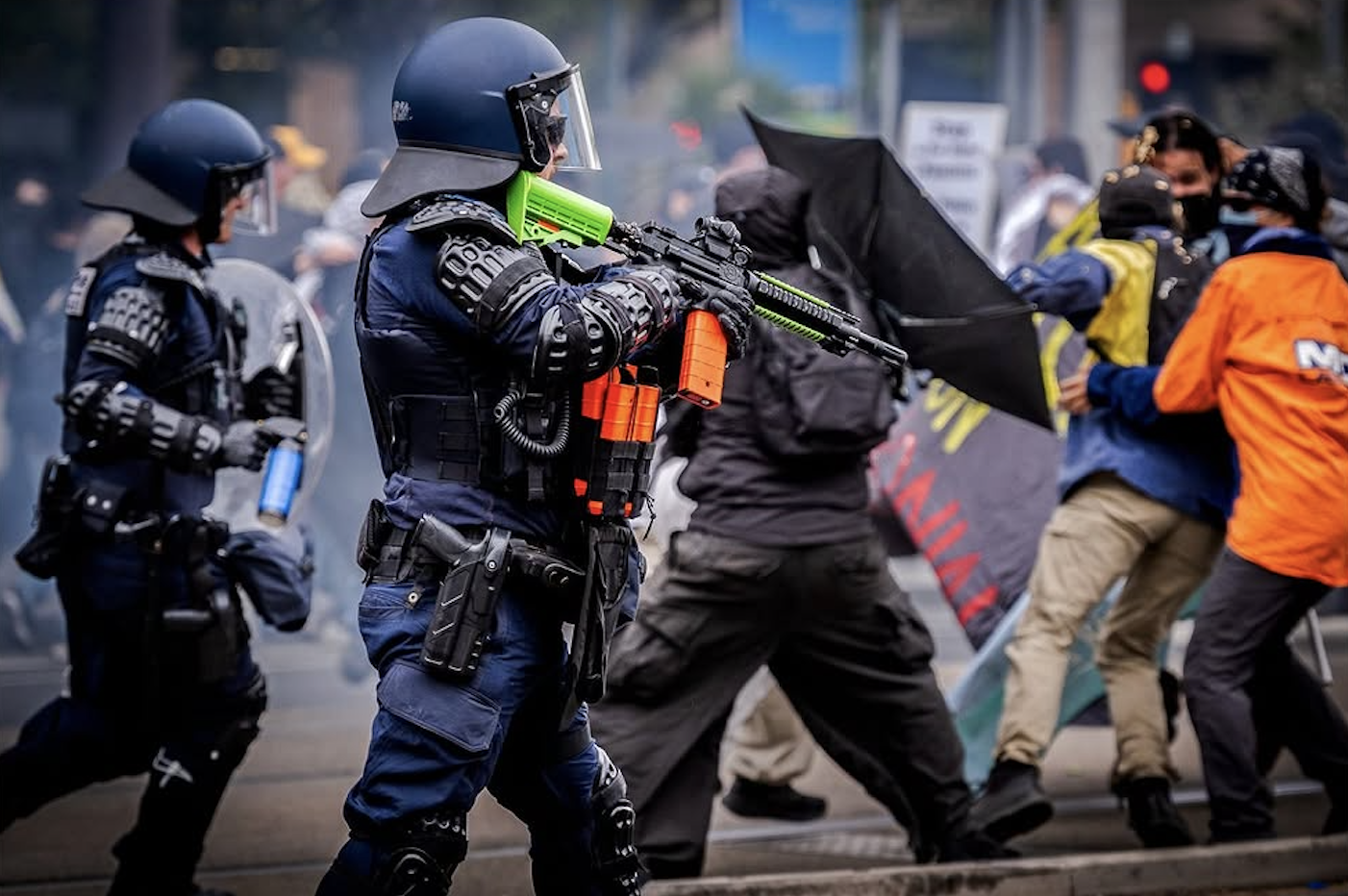
Police militarisation in Naarm is not speculative; it is visible in every contemporary protest formation. Flashbang grenades, OC spray, mounted units, shields, drones, high-resolution cameras and kettling strategies have become standard elements of the policing repertoire rather than exceptional measures deployed in extremis. Since the state’s loss of control on August 31st, escalation has intensified in a co-constitutive loop: police escalate, protesters adapt, police escalate again. This dynamic cannot be reduced to individual “bad choices” or the behaviour of a handful of militants. It expresses the operational logic of contemporary governance.
Recent media tours of Victoria Police’s Regional Operations Centre make this architecture explicit. From a central “mission control” room, senior command watch a wall of live feeds: Melbourne City Council CCTV, police drones hovering overhead, intelligence officers filming on the ground. A vast map of the CBD is annotated with markers representing units and key locations. Protesters appear as moving dots on a screen. Cameras can be swung and zoomed “within seconds” to focus on any given corner. Still images of faces are captured and passed to an investigations “cell”, who track people back through hours of footage to when they arrived unmasked. Masked participants from a previous protest are described as already “tracked and identified” from earlier in the day. Protest in Naarm is thus governed through an integrated, real-time visual grid that enables retrospective identification and targeted pursuit. This neo‑panopticon does not replace the physical nature of state violence but operates atop it, amplifying the reach of batons, shields, and chemical weapons with a digital layer of surveillance that extends coercion beyond the immediate encounter.
This is the first point at which Omar Hassan’s article falters. He treats repression as the reactive outcome of protester misjudgment. His argument reproduces the state’s moral playbook: repression appears when militants “go too far”, and, by implication, calmer behaviour could secure calmer policing. In this framing, the central question becomes whether protesters have behaved in a way that invites or deflects state violence.
The problem with this approach is that it misidentifies what repression is. Repression is not situational but architectural. It is a governing apparatus that organises bodies, vision, movement and political legibility. Protest does not occur in a neutral space into which police step only when provoked; it occurs inside an already-designed field of surveillance, containment and control. Protesters and police co-produce the scene of struggle, but only one of these actors holds a monopoly on force, control of infrastructure and the authority to define what counts as order. Repression, moreover, functions as a political pharmakon—both poison and catalyst. It is dialectical, simultaneously producing submission and resistance, fear and defiance, closure and possibility, and this dynamic extends beyond the binary of black bloc and non‑bloc protesters. It shapes the entire ecology of dissent, influencing how movements organise, how solidarity is built, and how collective risk is distributed across different bodies in the street. To treat repression as a reaction to militants is to collapse a complex power relation into a simple behavioural parable.
Black bloc formations arise less from ideological zeal than from organised responses to the very forms of state violence Hassan condemns. They are shaped by the experience of police abuse, chemical weapons, violent arrests and panoptic capture—not by exclusively bad faith agitators or theatrical confrontation. When participants mask up or form blocs, they are not inviting repression but responding to it as a permanent condition.
This leads to a second misconception: the nature of the black bloc itself. Hassan treats it as an ideological tendency, a parasitic quasi-faction whose theatrics undermine mass politics. In Naarm’s present conditions, this is inaccurate. The black bloc is not an ideology; it is a counter-apparatus engineered in response to pervasive surveillance, police abuse and targeting, automated and manual tracking of images and bodies, fascist voyeurism and harassment, and militarised crowd-control tactics. To condemn it as mere performance is to overlook the material and dialectical conditions that give rise to it.
Hassan’s account also reverses causality. In his telling, police violence erupts because militants escalate. The more accurate description, in Naarm, is that bloc tactics escalate because police violence and surveillance enforce narrow boundaries around “acceptable” dissent, reduce protest to sanctioned parades and punish those who step outside those containments. It is true that some people within the bloc may retaliate when confronted with excessive force, and such moments can feed a further cycle of escalation. Yet to single out the black bloc as a fringe formation that originates conflict mistakes effect for cause. The bloc is not the source of violence; it is a way of inhabiting and responding to a conflict that is already given.
There have been instances where mostly peaceful, unmasked protest lines have been kettled, struck, sprayed or charged without any black bloc present. Protesters of all forms have experienced excessive force and misconduct: indiscriminate violence and intimidation, weapons brandished, officers obscuring badge numbers while recording with personal devices, slurs and verbal abuse from police. High-quality cameras and drones systematically capture faces and bodies, feeding what is effectively a colonial-police databank—a contemporary neo-panopticon for managing dissent. These practices illustrate that the underlying policing logic does not depend on the presence of a black bloc. That logic is grounded in suspicion, containment and the production of fear. Under such conditions, tactics that prioritise safety, solidarity and anonymity are not fringe or parasitic; they are structurally necessary. The black bloc does not cause repression. Repression produces the bloc—or, more precisely, repression and bloc tactics are co-produced through each other. Hassan’s insistence otherwise inadvertently mirrors Victoria Police’s post-hoc story, amplified by politicians and media: “they made us do it”, “the left is a dangerous militant group”, and so on.
To be fair, Hassan does touch something real. Certain forms of violent or reckless behaviour can damage movements. Unaccountable groups who treat demonstrations as a stage for macho performance, arbitrary property damage or gratuitous clashes can alienate broader layers of potential supporters, hand easy narratives to the media, and genuinely disrupt patient organising work. The critique of consent here is important: when escalation exposes others to risk without their participation or consent, it crosses an ethical threshold. It is legitimate to criticise actions that endanger others or have no strategic relationship to building collective capacity.
But Hassan’s mistake is to conflate these problems with the black bloc as such, treating “the bloc” as a homogenous layer of bad-faith agitators. He takes concrete issues—escalation detached from collective strategy, lack of accountability, fantasy militancy—and pins them onto a tactical formation that exists as defensive and protective responses to the infrastructural millieu. The relevant distinction is not between black bloc and non-bloc protesters, but between strategic defence and pointless spectacle. Calling for the blanket exclusion of bloc formations collapses all of this nuance into a demand that those who take on the heaviest risks simply stay home.
His broader political claim—that only mass, working-class movements can effectively challenge the far right—rests on a romantic and reductionist reading of history. Decisive ruptures have emerged from a dialectic between the collective and the insurgent, between the disciplined rhythm of mass mobilisation and the pulse of militancy. Across contexts and eras, transformation has depended on this tension: the capacity of organised bodies to absorb and amplify the shock of those who act at the edge of possibility. It is not a matter of glorifying confrontation, but of recognising that every expansion of political space has required both the weight of numbers and the spark of defiance. Hassan’s framework, by isolating one from the other, erases the infrastructural role of militancy in shaping what movements can become.
This erasure feeds the central contradiction in his argument. He calls for unity, cohesion and disciplined mass action, yet simultaneously demands the exclusion of those who absorb the some of the greatest physical, legal and psychological risks. Solidarity cannot begin with expulsion. Black bloc participants are often the most tactically aware, best prepared and disciplined bodies in the space. They study police tactics, surveillance patterns, extraction risks and line security. Meanwhile, unmasked protesters are fully identifiable and trackable, funnelled along police-sanctioned routes and exposed to post-protest retaliation in workplaces, communities and online.
Removing the bloc does not protect the movement. It strips away part of the movement’s defensive capacity and redistributes risk back onto the most visible and precarious participants.
Underpinning Hassan’s stance is the familiar trap of respectability politics. His position reproduces the logic used by police and media: violence stems from “improper” protester behaviour; the state simply responds with “necessary” force. Respectability politics isolates militants, legitimises repression and keeps protest within governable aesthetic boundaries. It turns dissent into a civic ritual—something to be managed and displayed—rather than a disruption of the political order.
Movements require protection, not obedience to the state’s preferred optic of the “good protester” who stays on the footpath and trusts the police to honour the choreography. The insistence on respectability constrains not only tactics but also imagination; it narrows what feels thinkable and permissible in the face of an increasingly militarised apparatus.
The key question, then, is not whether the black bloc is “good”. The question is why the black bloc becomes necessary. In Naarm’s policing landscape, bloc tactics emerge from structural conditions, not from ideological purity. They are shaped by surveillance architectures, criminalisation patterns and the state’s intensified reliance on coercive force as a mode of governance. To eliminate the black bloc in any meaningful way would require dismantling the apparatuses that generate it: predictive policing, integrated CCTV and drone surveillance, data and image tracking, riot-control doctrines and the normalisation of police violence against dissent.
The black bloc is not a deviation from “proper” protest. It is a symptom of the policing regime—a tactical response to the conditions the state has created. To defend the movement’s capacity to act, we must start by understanding the forces that shape it, rather than lecturing those who navigate these conditions most directly.
Hassan’s analysis stops at the surface, focusing on conduct and optics. A politics capable of confronting contemporary repression must go deeper, into the architectures of power and the co-production of repression and resistance. Only there can questions of tactics, risk and solidarity be posed in a way that does justice to the world in which they are forced to operate.